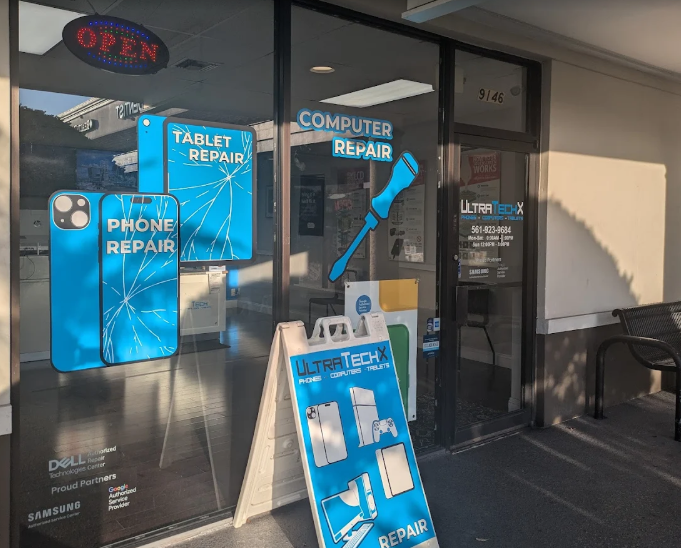
Your screen is shattered, you have a dozen tabs open, and every one of them is a repair shop claiming to be fast, cheap and the best in town. Figuring out how to choose a phone repair shop from that is genuinely hard, because the things that matter most - what part goes in, what the warranty really covers, who unlocks your phone - are exactly the things nobody advertises. This guide is the checklist we'd hand a friend: seven checks that separate a good shop from a risky one, the red flags worth walking away from, and the eight questions to ask before you drive anywhere. It applies to any shop in Boca Raton, including ours.
Why "Best Repair Near Me" Doesn't Answer the Question
Search for a repair shop and you get a map, a row of star ratings, and almost no information you can act on. Every shop is a 4.8. Every shop says "fast, affordable, expert." The ratings are real, but they're a blunt instrument - they tell you people were satisfied, not what they were satisfied with, and they don't distinguish a shop that fitted a quality display from one that fitted a cheap panel that failed four months later, after the reviewer had already left five stars.
The gap matters because a phone repair is a job you can't inspect. When the phone comes back, the glass is smooth and the picture is bright. You have no way of knowing which display went in, whether the waterproof seal was replaced, or whether the technician wrote down your passcode. All of that only shows up months later, or never.
So the useful move isn't to hunt for the highest rating. It's to ask the small number of questions that a good shop can answer instantly and a careless one can't answer at all.
The 7 Things to Check Before You Hand Over Your Phone
These are in the order we'd actually do them - the free ones first.
1. Read the last ten reviews, not the total
A shop with 400 reviews and a shop with 40 can be equally good. What separates them is recency and detail. Sort by newest and read ten. You're looking for three things:
- Do reviewers name the repair? "Screen done in 40 minutes" tells you more than "great service."
- Are there recent ones? A wall of five stars that stops eighteen months ago describes a shop that no longer exists in that form.
- How does the shop reply to the bad ones? This is the single most revealing thing on the page. Every busy shop gets a complaint eventually. A calm, specific reply that fixes the problem is worth more than a perfect record.
Ignore the number itself. A review count is a measure of how long a shop has been open, not how well it works today.
2. Get the price before you hand it over - and understand the diagnostic fee
For standard repairs like an iPhone screen or a battery, any shop should give you a firm number over the phone. If the quote comes with "we'll see when we open it" on a routine screen job, that's a shop leaving itself room.
The part that confuses people most is the diagnostic fee, so it's worth understanding what it is. When a device won't power on, won't charge, or has been near liquid, nobody can quote it honestly without opening it and testing. The diagnostic fee pays for that work. What you want to hear is: how much is it, and is it waived if I go ahead with the repair? A fee that disappears when you approve the job is a shop charging for its time only when it doesn't earn the repair. A fee that stays on the bill regardless is a shop charging you twice.
💡 A diagnostic fee is not a repair price
If you see a low number advertised - $29.99, say - check what it buys. At UltraTechX that figure is the diagnostic fee, waived when you go ahead with the repair. It has never been the price of a repair. iPhone screens start at $99, Galaxy screens at $79, and batteries at $69. Any shop advertising a repair at a price that low is almost certainly quoting you a diagnostic too.
3. Ask what part they're fitting
This is the question that separates shops most sharply, and almost nobody asks it. Replacement screens exist across a wide quality range - genuine manufacturer parts at the top, then quality aftermarket OLED and LCD panels, then the budget end where colour, brightness and touch response are all noticeably worse and the failure rate is higher.
You don't need to become an expert on part grades. You need one thing: a shop that answers the question directly. "We use OEM-quality OLED panels" is an answer. "We use the best parts available" is not - it's a sentence that survives any follow-up question. If a shop won't name what's going into your phone, assume the cheapest option and price accordingly.
4. Ask what the warranty covers, and for how long
Warranties on repairs vary from nothing at all to genuinely useful, and the length is the least important part. Ask three things:
- How long? Somewhere between 90 days and a year is normal for a good independent shop.
- Parts, labour, or both? A parts-only warranty leaves you paying for the second fitting.
- Is it written down? On the receipt, not said at the counter.
Treat a "lifetime warranty" with no written terms as marketing rather than coverage. Lifetime of what - the phone, the part, the business? Our own is 90 days on parts and workmanship, in writing, and we'd rather state a real number than an impressive one.
5. Ask who tests the repair, and where
Here's the thing most people get wrong about repair-shop privacy, and it's worth being straight about: a properly tested repair usually needs your passcode. A screen replacement isn't finished until someone has checked multi-touch across the whole panel, re-enrolled Face ID, and confirmed the front camera and earpiece work. Almost none of that can be verified from a lock screen. A shop that promises it will never unlock your phone is promising to hand it back untested.
So the useful question isn't whether they need access. It's who does the testing and whether you're in the room. Ask if they'll run the test at the counter in front of you before you leave. That single request turns an open-ended handover into a supervised few minutes, which is the actual difference that matters. We wrote about the research behind this in Is My Data Safe at a Phone Repair Shop? - the documented cases of snooping almost all involved devices left behind and used with nobody watching.
One genuine red line: no repair needs your Apple ID or Google account password. That's a separate credential from your device passcode, and no legitimate repair requires it. A shop asking for it is asking for something it cannot possibly need.
6. Ask for the honest timeline, not the fastest one
Speed is worth paying for, and most common phone repairs genuinely are quick - a screen or battery is typically 30 to 60 minutes at a shop that stocks the part. But timelines are also the easiest thing to bait with, and "20 minutes" quoted before anyone has seen your device usually becomes something else once you're standing in the shop.
A more useful question: do you have the part for my model in stock right now? That's what actually determines whether you wait 45 minutes or three days. And be sceptical of same-hour promises on the harder jobs. Laptops usually aren't a while-you-wait repair - we explain why in our guide to telling a cheap MacBook fix from a real repair - and liquid damage needs proper cleaning time if it's going to hold.
7. Walk in and look at the counter
Two minutes in person tells you what an hour of browsing can't. Look for:
- A fixed address and posted hours. A shop with a lease behaves differently from one that meets you in a parking lot.
- A real bench. Anti-static mats, proper tools, a microscope for board work. Repairs done on a countertop with a guitar pick are a different service.
- Somebody who'll explain the repair. Ask what's wrong with your phone and see whether you get a straight explanation or a sales pitch.
- A written ticket. Device, issue, agreed price, agreed warranty. If nothing gets written down, nothing has been agreed.
📱 Want to test all seven on us?
Walk in to 9146 Glades Rd and ask every question on this list before you commit to anything. Get a free quote or call (561) 923-9684.
5 Red Flags Worth Walking Away From
None of these prove a shop is bad. All five are worth a second look, and the last one isn't negotiable.
| Red flag | Why it matters |
|---|---|
| A firm price on a phone nobody has looked at | Fine for a standard screen or battery. On a device that won't turn on or has been wet, a confident quote sight-unseen is a number that will change later. |
| "Lifetime warranty" with nothing in writing | An unwritten warranty of any length is worth what it's written on. Ask for the terms on the receipt. |
| Vague answers about parts | "The best available" is not a part grade. A shop that won't name what it fits is usually fitting the cheapest option. |
| No fixed address | Mobile repair is a legitimate model, but check for a business address, posted hours and a real phone number somewhere. A meeting point isn't an address. |
| Asking for your Apple ID or Google password | The one true dealbreaker. Your device passcode is needed to test a repair; your account password never is. Stop the conversation here. |
"Authorized," "Certified," "Independent" - What the Labels Actually Mean
These three words get used almost interchangeably in repair advertising, and they mean very different things. Knowing the difference takes about a minute and makes you much harder to mislead.
Apple Authorized Service Provider (AASP)
A shop with a formal agreement with Apple. It can perform in-warranty and AppleCare+ repairs as well as out-of-warranty work, uses genuine Apple parts and diagnostics, and the repair is backed by Apple. If your phone is still under warranty or covered by AppleCare+, this is usually where to start, because that repair may cost you nothing.
Independent Repair Provider (IRP)
A separate Apple program, opened up in 2019, that lets established independent shops buy genuine Apple parts, tools, training and diagnostics for out-of-warranty repairs. An IRP can't process AppleCare+ claims, but has access to the same parts as an authorized provider.
Independent shop with certified technicians
The most common category, and the one most local shops fall into, including plenty of excellent ones. Here the meaningful credential is usually CompTIA A+, the general industry certification covering hardware, mobile devices, troubleshooting, security and operational procedure - you can see exactly what it covers on CompTIA's own certification page. It's a real qualification with real exams, and it says nothing about Apple authorization, which is fine as long as nobody implies otherwise.
💡 You can check this yourself in 30 seconds
Apple publishes a searchable directory of both programs. Type a shop's name into Apple's Repair Provider Verification page and you'll see whether it's an Authorized Service Provider, an Independent Repair Provider, or neither. Being in neither program is not a mark against a shop. Implying membership it doesn't have is.
"Ask us what we are and we'll tell you. We're an independent shop on Glades Rd, not an Apple Store. Our techs are CompTIA A+ certified and Apple-trained, our warranty is 90 days in writing, and if the honest answer to your question is that you should take it to Apple instead, we'll say that too."
— UltraTechX, 9146 Glades Rd, Boca Raton
Does Third-Party Repair Void Your Warranty?
This is the fear that pushes people into decisions that cost them money, and the legal reality is narrower than the rumour.
Under the federal Magnuson-Moss Warranty Act, it is illegal for a manufacturer to condition a product warranty on the use of its own branded parts or service unless it provides them free of charge. The Federal Trade Commission has enforced this repeatedly - in 2024 it again warned companies to stop warranty practices that harm consumers' right to repair, after earlier rounds of warning letters to phone, console and vehicle makers whose terms implied that independent service voided coverage. To deny a claim, a manufacturer has to show that the outside repair actually caused the failure.
Two practical caveats, because the law isn't the whole picture:
- If the device is still in warranty or on AppleCare+, go to the manufacturer first. Not because independent repair is forbidden, but because your repair may be free, and free beats cheap.
- Independent repair can affect the coverage of the part that was touched. A manufacturer isn't obliged to warrant a display it didn't fit - which is exactly why the shop's own warranty in check 4 matters.
For an out-of-warranty phone, which is most of the phones that get cracked, a good independent shop is usually faster and considerably cheaper. Our full model-by-model breakdown is in the iPhone screen repair cost guide.
The 8 Questions to Ask on the Phone
Copy these. Two minutes on the phone with each shop will separate them faster than an hour of reading reviews.
- What will this cost, and is that the final price?
- Is there a diagnostic fee, and is it waived if I go ahead?
- What part will you fit, and where does it come from?
- What does the warranty cover, and for how long?
- Do you have the part for my model in stock today?
- Do you need my passcode, and what exactly will you test with it?
- Will you run that test in front of me before I leave?
- What happens if the repair fails next month?
You're listening for fluency more than for any particular answer. A shop that has answered these a thousand times answers them in a sentence each. A shop that hesitates on question three or six is telling you something.
How We'd Answer Our Own Seven
It would be a strange article that told you to interrogate every shop in Boca Raton and then skipped itself. So, plainly:
| The check | Our answer |
|---|---|
| Reviews | 410+ five-star Google reviews from West Boca neighbours you can look up by name |
| Price | Firm quote you approve before any work. $29.99 diagnostic, waived with the repair. iPhone screens from $99, Galaxy screens from $79, batteries from $69 |
| Parts | OEM-quality displays and batteries; ask at the counter and we'll tell you exactly what's going in your model |
| Warranty | 90 days on parts and workmanship, in writing on your ticket |
| Data | We ask for your passcode, we tell you what we're testing, and we run that test at the counter in front of you |
| Timeline | Most phone repairs 30-60 minutes while you wait; walk in before 5 PM for same-day. Laptops and board work get an honest multi-day timeline instead |
| The counter | 9146 Glades Rd, West Boca Raton. Mon-Sat 10am-7pm, Sun 12pm-5pm. Certifications on the wall, CompTIA A+ certified and Apple-trained technicians, BBB accredited |
We're an independent repair shop, not an Apple Store, and there are days when the honest answer is that you should take a phone still under AppleCare+ to Apple instead. We say so - it costs us one repair and it's how a shop ends up with reviews worth reading. If you want the commercial version of this pitch rather than the checklist, it's on our best iPhone repair shop in Boca Raton page, and our credentials are set out on the certified iPhone technician page. Everything we fix is listed under iPhone repair, and if you're in a hurry today, start with same-day repair.
❓ Frequently Asked Questions
How do I know if a phone repair shop is trustworthy?
Judge a shop on what it will put in writing, not on its star rating. A trustworthy shop gives you a firm price before it starts, tells you plainly what part it's fitting and where it comes from, states a warranty in writing with a length and a scope, explains who will test the repair and where, and gives you an honest timeline rather than the fastest one. Read the ten most recent reviews rather than the total count, and pay particular attention to how the shop replies to the bad ones.
Are third-party phone repairs safe?
Yes, when the shop is transparent about parts, warranty and testing. Independent repair is a normal, legal option in the US, and for an out-of-warranty device it's usually faster and cheaper than mailing a phone away. What makes a repair risky isn't that the shop is independent - it's a shop that won't say what part it's fitting, won't put a warranty in writing, or quotes a price that changes once the device is open. Ask those questions and most of the risk disappears.
Does third-party phone repair void my warranty?
Not automatically. Under the Magnuson-Moss Warranty Act it's illegal for a manufacturer to condition a warranty on the use of its own parts or service, and the FTC has repeatedly warned companies whose terms implied otherwise. To deny a claim, a manufacturer has to show the independent repair actually caused the failure. That said, if your device is still under an active manufacturer warranty or AppleCare+, take it to the manufacturer first - that repair is often free. Independent repair makes the most sense once coverage has expired.
What does an "Apple certified technician" mean?
It's used loosely, so ask what's meant. Apple runs two formal programs: Authorized Service Providers, which handle in-warranty and AppleCare+ repairs, and Independent Repair Providers, which can buy genuine Apple parts for out-of-warranty work. You can check any shop against Apple's own Repair Provider Verification directory. Many good local shops are in neither program and are staffed by CompTIA A+ certified technicians, which is the general industry credential for hardware and device troubleshooting. None of that is disqualifying - what matters is that a shop tells you plainly which it is.
What questions should I ask before choosing a repair shop?
Eight, on the phone, before you drive anywhere: What will this cost, and is that final? Is there a diagnostic fee, and is it waived if I go ahead? What part will you fit, and where does it come from? What does the warranty cover and for how long? Do you have the part in stock today? Do you need my passcode, and what will you test with it? Will you test it in front of me? And what happens if the repair fails next month? A shop that answers all eight without hesitating has answered them many times before.
Should I just choose the cheapest phone repair shop?
Price is fair to compare, but the lowest quote is often the least complete one. A screen quote well below everyone else usually means a lower-grade panel, a shorter warranty, or a number that grows once the device is open. Compare the whole package: price, part, warranty length, and whether the quote is firm. At UltraTechX in Boca Raton, iPhone screens start at $99 and Galaxy screens at $79, with a 90-day warranty on parts and workmanship, and the price you approve is the price you pay.